POWER YOUR BUSINESS!
CHARGE UP YOUR DAY!
ELECTRIFY YOUR MOBILITY



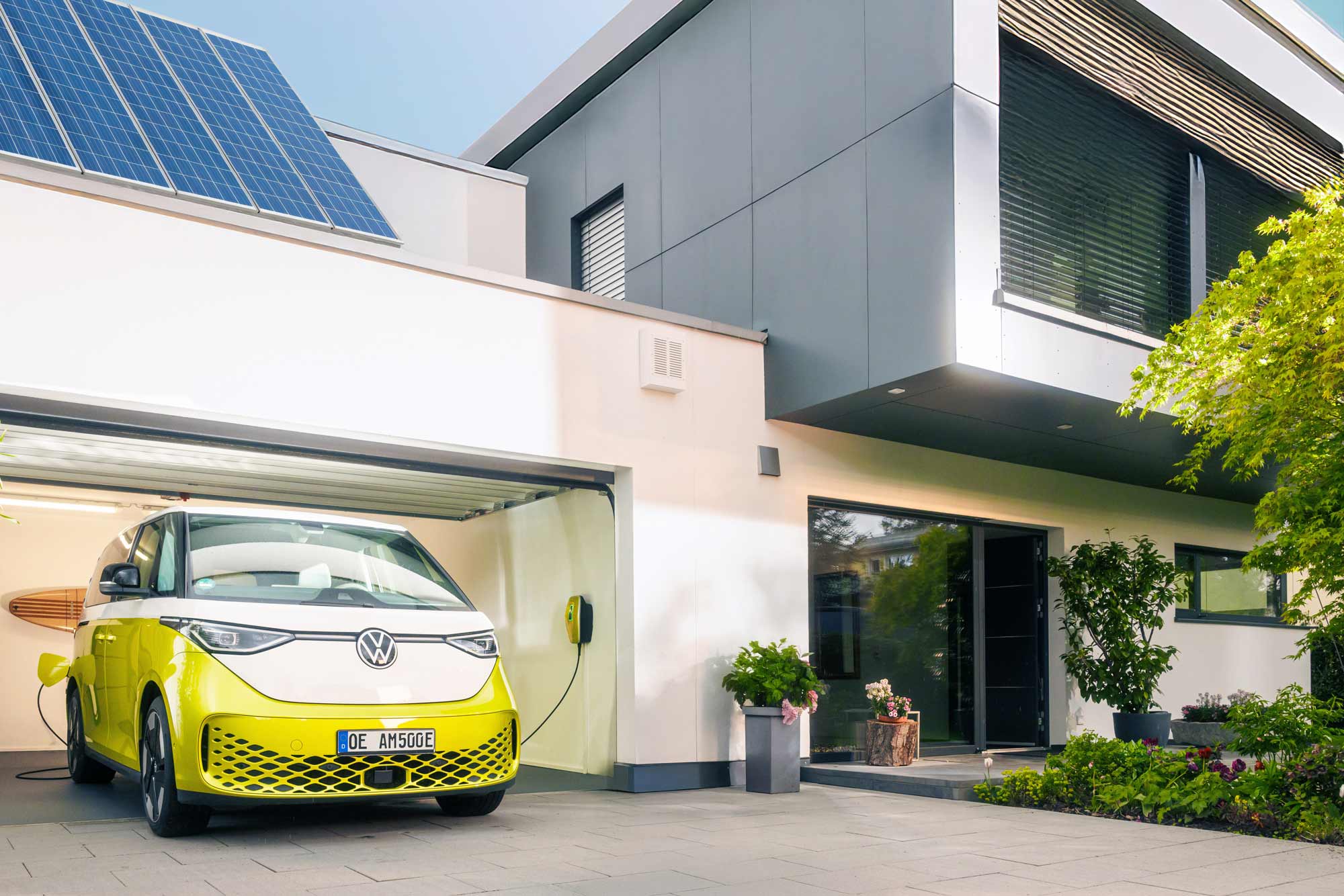
Today, electric cars are primarily a convenient means of transport, offering driving pleasure without disruptive engine noise. But very soon, thanks to bidirectional charging, EVs will also act as decentralized energy storage units on the move. Instead of sitting fully charged in parking lots most of the time, EVs will increasingly contribute to energy autonomy at home and relieve the public power grids. Electricity from vehicle batteries will in the future be able to flow back into both home and public grids.
When EVs will be permitted to function as energy storage systems in Europe, and how bidirectional charging works in detail, you can find out here.
Bidirectional charging enables both the charging and the discharging of a vehicle’s battery. This unlocks a wide range of possibilities for energy optimization and energy use. All forms of bidirectional charging are grouped under the term Vehicle‑to‑Everything (V2X). Depending on the specific scenario, additional, more specialized terms are used:
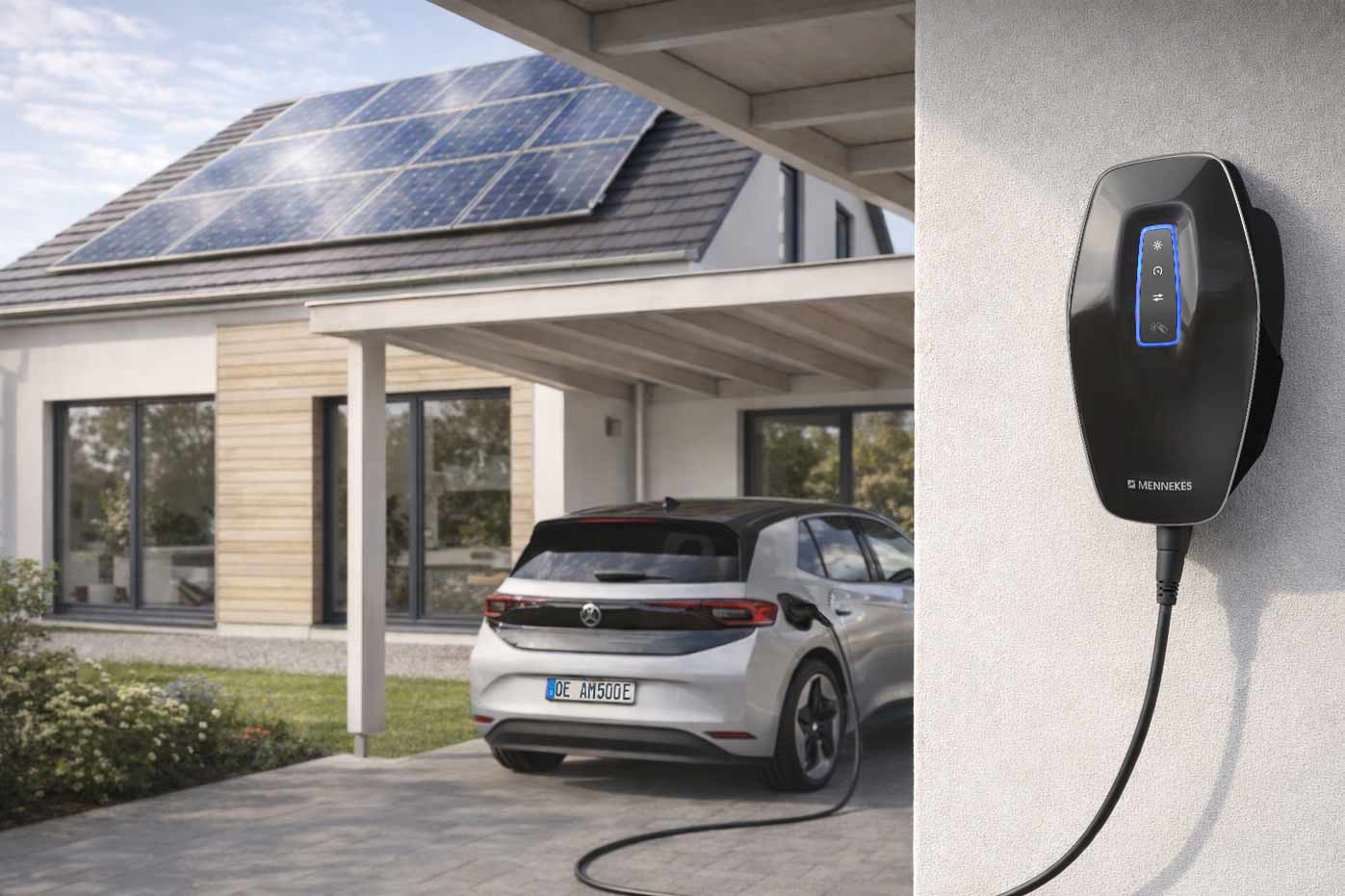
Bidirectional charging at home is referred to as Vehicle‑to‑Home (V2H). For homeowners, this can mean that smaller and more affordable home storage systems are sufficient for their PV installation – because they can use their EV to store surplus solar energy. With bidirectional charging, this energy can be fed back into the home or the power grid via the wallbox whenever needed. Compared to common home battery systems used today, this offers a significant advantage:
With the typical battery capacities of electric vehicles (often more than 50–60 kWh), the electricity demand of a four‑person household could theoretically be covered for around four days.
Research projects show that the degree of energy autonomy and the share of self‑consumed solar energy can be increased to 80–90% through bidirectional charging – naturally depending on how the vehicle is used.
With Vehicle‑to‑Grid (V2G), electricity flows from the EV through the wallbox directly into the public grid. This offers two major advantages:
In the future, EV drivers may even receive financial compensation for feeding energy into the public grid. The first providers offering corresponding V2G electricity tariffs are already entering the market.
The term Vehicle‑to‑Building (V2B) is often used to describe applications in commercial environments.
Bidirectional charging can, for example, help reduce peak loads or support the local power supply within a building or business facility.
Vehicle‑to‑Device (V2D) or Vehicle‑to‑Load (V2L) enables the direct use of the energy stored in the vehicle battery to operate or charge various devices. The term Vehicle‑to‑Vehicle (V2V) is used when another electric vehicle is being charged.
Bidirectional charging cannot be implemented simply through a software modification or update. The ISO 15118 standard series governs communication between electric vehicles and charging stations. It complements the conventional pulse‑width modulation (PWM) communication defined in IEC 61851‑1. Based on a powerful Powerline Communication (PLC) link, ISO 15118 enables detailed data exchange between the vehicle and the charging station. With the latest update ISO 15118‑20 AMD1, the required extensions for bidirectional charging have now been incorporated into the standard.
But more is needed: In bidirectional AC charging, system functions are divided between the vehicle and the wallbox. The vehicle contains the on‑board charger (OBC), which ultimately generates AC power and feeds it back. The wallbox operates as an intelligent control hub, continuously communicating with both the EV and the electrical grid, monitoring and synchronizing the bidirectional energy flow.
The entire system must be independently certified according to the requirements of grid operators, and professional installation must be verified to ensure safe operation for users.


There is an increasing number of EVs on the market that support bidirectional charging. The implemented technologies differ in whether bidirectional charging is supported via alternating current (AC) or direct current (DC). Many vehicle manufacturers already offer proprietary DC solutions. At the same time, work is underway on interoperable AC solutions that will enable a cross‑manufacturer, fully compatible ecosystem.
The specific requirements for this will be defined for the first time in the new edition of the product standard for charging stations, IEC 61851‑1 Ed. 4, which is expected to be published in early 2027. Therefore, ISO 15118 compatibility alone is not sufficient to enable bidirectional functionality. A technical upgrade of today’s wallboxes is not sufficient – the existing device must be replaced by a bidirectional wallbox with the required hardware.
Bidirectional charging technology is highly promising, but several challenges and obstacles still need to be addressed – ranging from increasing self‑consumption and energy autonomy in the private sector (V2H) to providing and using balancing energy or neighborhood‑level backup power in blackout scenarios (V2G).
In addition to the incomplete standardization work, the National Centre for Charging Infrastructure has already identified several regulatory barriers that must be resolved before bidirectional charging can be deployed on a broad scale. It has also issued concrete recommendations for policymakers. Unresolved issues related to tax law, grid fees, electricity pricing, and data protection are being addressed by the European Parliament and national governments, and some of them have already been partially implemented across Europe.
Another key factor is the high cost of current bidirectional wallboxes, which makes V2H applications less attractive for private users. Current proprietary solutions also come with limitations that further reduce their appeal: they often work only with one specific vehicle model and one specific wallbox – or only in combination with a specific electricity contract. Compatibility with home energy storage systems or energy management systems is also not always available, or only to a very limited extent. However, when making an investment decision, future viability, interoperability, and flexibility in choosing components and services are essential.
Standardization at the European level continues to progress: A key foundation for interoperable solutions – the new generation of the product standard for charging stations, IEC 61851‑1 Ed. 4 – is expected to be published in early 2027. In parallel, the communication standard ISO 15118‑20 AMD1 and the corresponding vehicle standard for AC charging (ISO 5474‑2 AMD1) are under development and will be released by then.
Uniform grid‑connection requirements across Europe are being developed as part of the Network Codes Requirements for Generators (NC RfG 2.0).
To bring bidirectional charging into mass deployment, further research, practical experience, and new standards and regulations are required. Bidirectional AC charging for the broad European market will therefore be available no earlier than 2027. Before that, no interoperable solutions will be on the market. In the DC sector, development is already more advanced – but not yet based on interoperable product standards.